
Agriculture 4.0 in Sicily, in Italy, in Europe: emerging technologies and climate risk mitigation
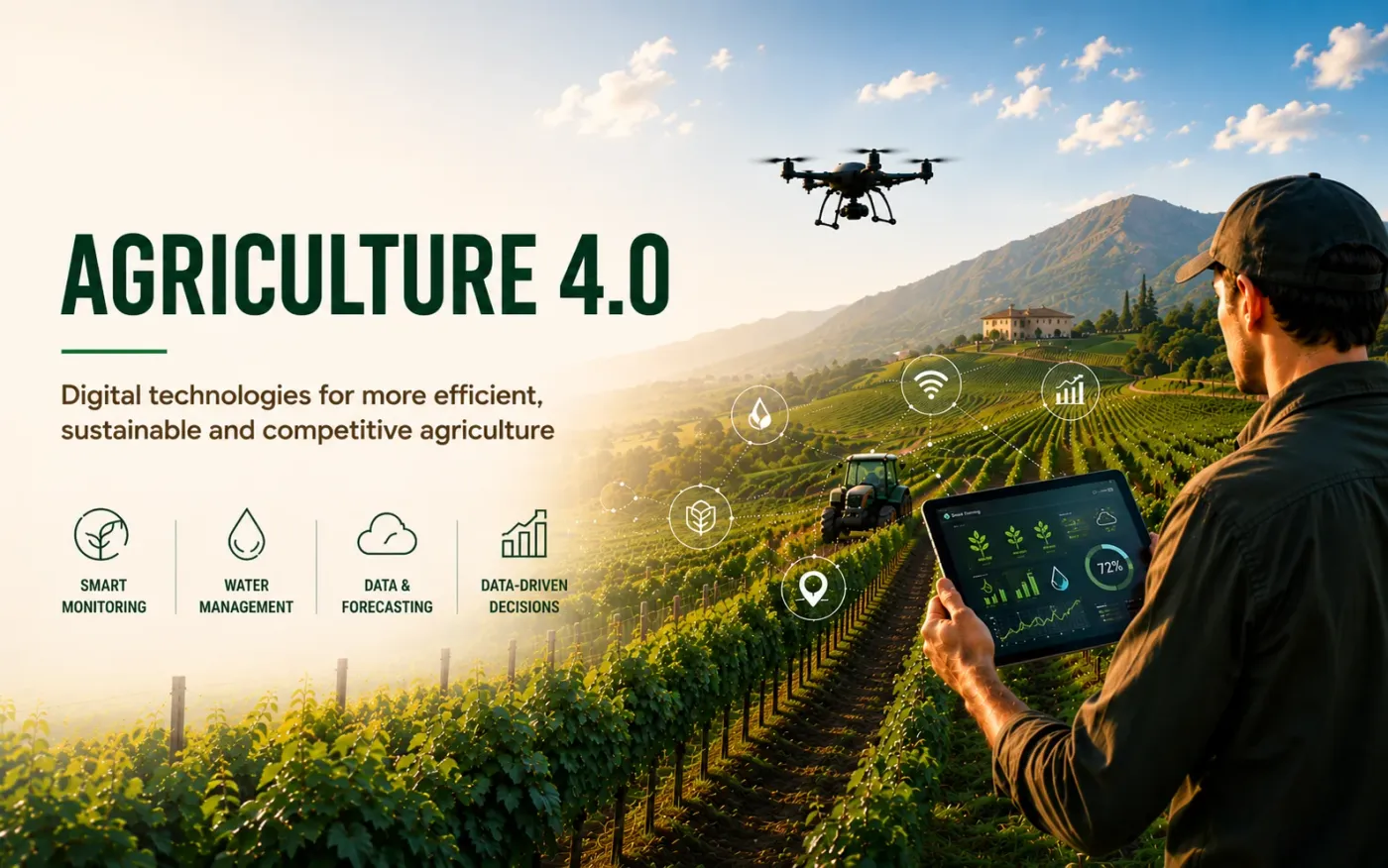
Over recent decades, European agriculture has been undergoing an unprecedented transformation, driven by the convergence of technological innovation and environmental necessity. The intensification of extreme climate events—prolonged droughts, heatwaves, irregular precipitation patterns, and soil erosion—demands a profound rethinking of production models, particularly in Mediterranean areas where ecological fragility and water scarcity are combined with a high economic dependence on agriculture. In this context, Agriculture 4.0 is emerging not only as an innovative production paradigm, but as a genuine tool for climate mitigation and adaptation, capable of reducing environmental impact and increasing the resilience of rural communities.
The concept of Agriculture 4.0 arises from the integration of traditional agronomy, environmental sciences, and digital technologies. It represents the extension of the “fourth industrial revolution” to the agricultural sector, characterized by the interconnection of physical and digital systems through the Internet of Things (IoT), Artificial Intelligence (AI), advanced robotics, process automation, big data analytics, and the use of cloud platforms for integrated information management. This approach makes it possible to collect, process, and interpret large volumes of data in real time from sensors, drones, satellites, and smart machinery, translating such information into targeted, sustainable, and highly efficient operational decisions.
In Sicily, a key region of the Mediterranean basin, the adoption of Agriculture 4.0 technologies takes on strategic importance. The Sicilian territory represents a natural laboratory for agriculture under extreme climatic conditions: high temperatures, increasing water stress, soil desertification, and the loss of agricultural biodiversity constitute structural challenges to the survival of many traditional crops. Yet it is precisely from this complexity that the opportunity emerges to develop adaptive agricultural models based on innovation, monitoring, and digitalization.
At the national level, Italy ranks among the most active European countries in promoting Agriculture 4.0. The National Recovery and Resilience Plan (PNRR) and the National Strategy for Digital Agriculture emphasize the need to digitalize the agri-food supply chain, support the adoption of precision technologies, and strengthen digital skills training in rural areas. Italian experiences show that the introduction of sensors and data analytics is no longer the exclusive domain of large enterprises, but is progressively reaching agricultural SMEs, cooperatives, and business networks as well.
Within the European context, Agriculture 4.0 is closely linked to the Green Deal and the Farm to Fork Strategy. The European Union aims to achieve climate neutrality by 2050, and the agricultural sector plays a decisive role in this challenge. Digitalization, the circular economy, the reduction of greenhouse gas emissions, and the protection of soil fertility are central objectives of EU policies, supported by programs such as Horizon Europe, LIFE, and the CAP 2023–2027.
The main challenge remains territorial disparity: while Northern Europe has already reached advanced levels of agricultural digitalization, Mediterranean regions still show structural delays linked to land fragmentation, inadequate infrastructure, and limited access to broadband connectivity. In Sicily and Southern Italy, the adoption of Agriculture 4.0 technologies therefore requires a systemic approach that combines economic incentives, professional training, and technical support.
From a forward-looking perspective, Sicily can serve as a model of experimentation for the entire Mediterranean area. Thanks to the combination of extreme climatic conditions, agricultural biodiversity, and a millennia-old farming tradition, the island represents an ideal testing ground for new solutions in climate-smart agriculture and digital farming. In conclusion, Agriculture 4.0 is not merely a technological revolution, but a cultural and environmental one that redefines humanity’s relationship with the land.
Context and Meaning of Agriculture 4.0
Agriculture 4.0 did not emerge as a theoretical concept or as a simple technological upgrade of the primary sector, but as a concrete and necessary response to the daily difficulties that farmers and rural territories are increasingly facing. In recent years, work in the fields has become more complex and uncertain: seasons no longer follow recognizable patterns, rainfall has become irregular, heatwaves are intensifying, and water availability is declining. Added to this are rising energy costs, volatile agricultural markets, and growing pressure on farm profitability, especially for small and medium-sized enterprises. In this scenario, continuing to produce “as it has always been done” is no longer a neutral choice, but a tangible risk to the very survival of agricultural activity.
Agriculture 4.0 fits into this context as an evolution in the way agricultural reality is observed, managed, and interpreted. It is not about replacing farmers with technology, nor about indiscriminately automating every stage of the production process. On the contrary, the core of this paradigm lies in strengthening the human role through tools that enable more informed, timely, and conscious decision-making. Field experience, territorial knowledge, and intuition developed over years of work remain fundamental, but they are complemented by measurable data that reduce uncertainty and help prevent costly mistakes.
The transition toward digitalized agricultural models also marks a profound cultural shift. Traditionally, agriculture has relied on relatively stable seasonal cycles and on the transmission of knowledge based on direct observation and intergenerational experience. Today, however, these reference points are weakening: the climate is changing faster than past experience can predict, and decisions made “out of habit” may prove ineffective or even harmful. Agriculture 4.0 introduces a new way of observing the field, in which soil, crops, and the environment become measurable systems that can be monitored over time and interpreted through objective indicators.
A central aspect of Agriculture 4.0 is the shift from uniform crop management to differentiated and targeted management. Each plot of land—and often each individual section of a field—has its own characteristics in terms of soil, exposure, moisture, and microclimate. Treating everything in the same way means ignoring this complexity, resulting in wasted resources and reduced production efficiency. Digital technologies, by contrast, make it possible to intervene only where and when necessary, optimizing the use of water, fertilizers, and crop protection products.
In territories such as Sicily, the significance of Agriculture 4.0 takes on an even more relevant dimension. Here, agriculture is not merely an economic sector, but an identity-defining, cultural, and landscape-shaping element. Many farms are family-run and operate in challenging climatic contexts characterized by chronic water stress, fragile soils, and a growing exposure to climate risks. When properly adapted to the local context, Agriculture 4.0 can help Sicilian farmers preserve traditional crops, enhancing their resilience without undermining their historical and territorial value.
Today, agricultural systems are no longer expected merely to produce food, but to do so in a sustainable, traceable, and responsible manner. Consumers are increasingly attentive to product origins, the environmental impact of supply chains, and the overall quality of production. Digitalization makes it possible to respond to these expectations through traceability, certification, and monitoring systems that render the production process more transparent.
It is important to emphasize that Agriculture 4.0 is not a single, standardized model. Its effectiveness depends on the ability to adapt technologies to the specific characteristics of territories, crops, and farms. The true meaning of Agriculture 4.0 lies in the balanced integration of technical innovation and local knowledge, of digital tools and human skills. It is a gradual process that requires training, ongoing support, and a long-term vision.
Agriculture 4.0 and Climate Change: From Vulnerability to Resilience
Climate change today represents one of the main sources of instability for agricultural systems worldwide. According to reports by the Intergovernmental Panel on Climate Change (IPCC), rising average temperatures, the increased frequency of extreme events, and alterations in precipitation regimes are directly affecting agricultural productivity, soil fertility, and the availability of water resources. In Southern Europe and, in particular, in the Mediterranean basin, these effects are amplified, making agriculture one of the economic activities most exposed to climate risk. In this context, Agriculture 4.0 emerges as a key tool for transforming a condition of structural vulnerability into a pathway toward adaptive resilience.
Agriculture 4.0 first and foremost enhances the capacity to observe agricultural systems. Climate sensors, on-farm weather stations, satellite imagery, and drones make it possible to collect continuous data on temperature, humidity, soil water status, and crop development. Once integrated into digital platforms, this information enables real-time monitoring of environmental conditions and the early detection of stress signals. Farmers are no longer forced to react only when damage has already become evident, but can intervene preventively, adapting cultivation practices to the actual conditions of the field.
A central aspect of climate resilience is efficient water management. Agriculture accounts for approximately 70% of global freshwater withdrawals, and in Mediterranean regions water scarcity represents a structural constraint. Precision irrigation technologies, based on soil moisture sensors and predictive models, make it possible to deliver water only when and where it is truly needed. This approach reduces waste, limits soil salinization, and helps preserve water resources over the long term.
Beyond water, Agriculture 4.0 also affects the overall management of production inputs. The targeted use of fertilizers and crop protection products, supported by variability maps and decision support systems, helps reduce greenhouse gas emissions associated with agricultural production. The adoption of precision practices makes it possible to limit the excessive use of chemical inputs, while simultaneously improving soil health and microbial biodiversity—both fundamental elements for the resilience of agricultural ecosystems.
In the Italian and Sicilian context, climate risk takes on specific characteristics. Rising average temperatures, reduced winter precipitation, and the intensification of summer heatwaves are profoundly altering the agricultural vocation of many territories. Traditional crops such as grapevines, citrus fruits, and olive trees are showing increasing signs of stress, with consequences for both the quality and quantity of production. Agriculture 4.0 offers the possibility to accompany these changes gradually, adapting cultivation practices without abandoning the productive identity of the territory.
An often overlooked but central element is the contribution of Agriculture 4.0 to risk management. Digital systems enable the integration of climatic, agronomic, and economic data into increasingly sophisticated risk assessment models. This not only helps reduce production losses, but also improves access to insurance and financial instruments based on objective data. The digitalization of agriculture can foster the development of fairer and more efficient risk management mechanisms, strengthening the economic stability of farms.
From a human and social perspective, climate resilience is not only a technical issue, but also one of continuity in agricultural work. Reducing uncertainty makes farming less exposed to sudden shocks and more attractive to younger generations. In many European rural areas, land abandonment is also linked to the perception of agriculture as an activity that is too risky and insufficiently predictable. By providing tools for monitoring and forecasting, Agriculture 4.0 indirectly helps counter this phenomenon, strengthening the link between people, territory, and production.
Emerging Technologies and Concrete Applications
If Agriculture 4.0 represents a cultural and systemic response to the climate crisis, it is now necessary to enter the operational core of this paradigm: emerging technologies and the way they transform data into concrete agricultural decisions. The true innovation of Agriculture 4.0 does not lie in any single technology, but in the ability to integrate different tools into a coherent system that supports farmers in their daily decision-making processes.
At the core of Agriculture 4.0 lies the systematic collection of data. Sensors installed in the soil, on plants, or on agricultural machinery record key parameters such as moisture, temperature, electrical conductivity, nutritional status, and vegetative growth. These data are complemented by information from on-farm weather stations, satellite imagery, and drone surveys. The combined use of satellite data and field sensors represents one of the most promising tools for improving the sustainable management of agricultural resources in Europe.
This is where Decision Support Systems (DSS) come into play, often based on artificial intelligence algorithms and predictive models. These systems analyze large volumes of historical and real-time data, identifying correlations, trends, and risk scenarios. DSS do not make decisions in place of the farmer, but provide probabilistic guidance that helps determine the optimal timing for irrigation, fertilization, or intervention against plant diseases. The adoption of DSS in agriculture can improve resource efficiency by up to 20–30%, while simultaneously reducing the environmental impact of farming practices.
A particularly relevant field of application is water management. Smart irrigation systems, connected to soil moisture sensors and predictive climate models, make it possible to schedule irrigation dynamically, adapting it to the actual needs of crops. Studies conducted by the European Commission show that precision irrigation can reduce water consumption by up to 40% without penalizing yields. In Sicily, where water is a limited and often costly resource, this type of technology represents a crucial step toward the economic sustainability of farms.
Another pillar of Agriculture 4.0 is the use of remote sensing technologies, particularly satellite imagery and drones. These tools enable large-scale monitoring of crop conditions, allowing the detection of variations in vegetative vigor, water stress, or pest attacks before they become visible to the naked eye. The NDVI (Normalized Difference Vegetation Index), widely used in precision agriculture, makes it possible to assess plant health and to intervene in a targeted manner.
Alongside monitoring, automation and agricultural robotics are progressively assuming an increasingly important role. Tractors with assisted or autonomous guidance, machinery for variable-rate input application, and automated harvesting systems help increase the precision of agricultural operations, reducing errors and waste. These technologies are not intended to eliminate human labor, but to make it less physically demanding, safer, and more skilled.
In the Italian and Sicilian context, however, the application of emerging technologies requires particular attention to farm scale. Many farms operate on limited land areas and with constrained financial resources. In such cases, Agriculture 4.0 cannot be conceived as a set of costly and complex solutions, but rather as a gradual pathway of technological adoption. Shared digital platforms, cooperative technological service models, and “light” precision agriculture approaches represent realistic solutions to facilitate access to innovation even for smaller operations.
Public Policies, Investment, and Human Capital
After analyzing the cultural meaning of Agriculture 4.0, its role in climate resilience, and the technologies that enable its concrete application, one central point emerges clearly: agricultural innovation cannot develop spontaneously or solely through individual efforts. For Agriculture 4.0 to become a structural driver of transformation, rather than a practice limited to a few advanced cases, it requires a favorable environment shaped by coherent public policies, targeted investments, and the development of human capital.
At the European level, Agriculture 4.0 fits into a now well-established policy framework that recognizes agriculture as a strategic sector in the ecological transition. The European Green Deal and the Farm to Fork Strategy set clear objectives in terms of emissions reduction, sustainable resource use, and biodiversity protection, identifying digitalization as one of the key tools to achieve these goals. Within this framework, the Common Agricultural Policy (CAP) 2023–2027 introduces specific measures to incentivize the adoption of precision technologies, sustainable soil management, and efficient water use.
In Italy, the theme of agricultural innovation has been further strengthened by the National Recovery and Resilience Plan (PNRR), which allocates significant resources to the digitalization of agri-food supply chains, infrastructure modernization, and technology transfer. The objective is to increase the competitiveness of the Italian agricultural sector while simultaneously reducing its vulnerability to climate risks.
The case of Sicily is emblematic. On the one hand, the region has high potential for the application of Agriculture 4.0, thanks to crop diversity, the importance of the agricultural sector, and strong exposure to climate risks. On the other hand, persistent structural limitations remain, linked to land fragmentation, insufficient digital infrastructure, and uneven access to technical training. In this context, public policies must play a mediating role, fostering collective models of innovation and reducing economic and cultural barriers to entry.
A key factor in the diffusion of Agriculture 4.0 is investment—not only in technologies, but also in support services. The most effective experiences at the European level show that the adoption of digital technologies is faster when farmers can rely on advisory networks, technical assistance, and continuous support. Investment in “intangible” infrastructure, such as data-sharing platforms and analytical services, is therefore just as important as the purchase of sensors or machinery.
Human capital is perhaps the most decisive variable. Agriculture 4.0 requires new skills that go beyond traditional agronomic knowledge. The ability to interpret data, familiarity with digital tools, understanding of predictive models, and awareness of environmental impacts become central elements of agricultural work. The lack of digital skills is one of the main obstacles to the adoption of precision agriculture in European countries, particularly among older generations. For this reason, continuous training and technical education must be considered an integral part of innovation policies.
From a human perspective, investing in human capital also means restoring dignity and attractiveness to agricultural work. The introduction of Agriculture 4.0 can help change this perception, transforming the farmer into a manager of complex systems, capable of using advanced tools and engaging with the worlds of research and innovation. This aspect is particularly relevant for generational renewal, one of the structural challenges facing the European agricultural sector.
Critical Issues, Limitations, and Future Perspectives
After analyzing the role of Agriculture 4.0 as a cultural, climatic, technological, and political response to ongoing transformations, it is necessary to explicitly address its critical issues and limitations. A mature reflection on agricultural innovation cannot overlook a realistic assessment of the operational, economic, and social difficulties that accompany the digitalization of the primary sector, especially in Mediterranean territories.
A first critical issue concerns inequality in access to technologies. The adoption of digital technologies in agriculture remains heavily concentrated in large-scale enterprises and in the most economically advanced regions. In Mediterranean contexts, and particularly in Southern Italy and Sicily, many farms operate with limited margins and fragmented land holdings, making it more difficult to bear the start-up costs of Agriculture 4.0 solutions. This risk of an “agricultural digital divide” could exacerbate territorial disparities.
A second limitation relates to the complexity of data management. Agriculture 4.0 is based on the collection and analysis of large volumes of information, but the effective management of these data requires skills that are not always available at the farm level. One of the main obstacles to the adoption of digital agriculture is the difficulty many farmers face in correctly interpreting data and translating them into operational decisions. Without adequate technical support, there is a risk that technology may be perceived as opaque and unreliable, generating mistrust rather than confidence.
A further critical element is technological dependence. The use of proprietary digital platforms, closed software, and systems based on external infrastructures raises questions about agricultural data sovereignty. The concentration of control over agricultural data in the hands of a few technology operators could limit farmers’ decision-making autonomy and create new forms of economic dependence.
Despite these critical issues, the future prospects of Agriculture 4.0 in Mediterranean territories remain significant. One of the most promising directions is the development of modular and scalable technological solutions designed specifically for small and medium-sized farms. Low-cost sensors, open-source platforms, and shared digital services can reduce barriers to entry and make innovation more accessible.
Another relevant perspective concerns the integration of Agriculture 4.0 with agroecological practices. Digitalization should not be viewed as being in opposition to sustainable agricultural models, but rather as a tool to support their implementation. Soil monitoring, the management of functional biodiversity, and the optimization of crop rotations can all be strengthened through the use of data.
Towards an Integrated Model: Synthesis and Long-Term Vision
After exploring the different dimensions of Agriculture 4.0—cultural, climatic, technological, political, and critical—it becomes necessary to recompose the overall picture into an integrated vision. The central question is: how can Agriculture 4.0 become a stable, equitable, and genuinely sustainable model for Mediterranean territories, and for Sicily in particular?
The first point of synthesis concerns the systemic role of Agriculture 4.0. It is not a simple sum of technologies, but a set of relationships among data, decisions, people, and institutions. The climate resilience objectives cannot be achieved without the technologies that enable them; likewise, these technologies remain ineffective without the support of public policies and human capital. Agriculture 4.0 functions only when conceived as an ecosystem rather than as a fragmented intervention.
Evidence provided by international organizations such as FAO, IPCC, and the European Commission converges on one point: there are no universal solutions valid for all agricultural contexts. In Mediterranean territories—characterized by high climatic variability, limited water resources, and strong farm fragmentation—Agriculture 4.0 must be adapted, modulated, and simplified. Sicily should not pursue external models, but rather build its own innovation pathway consistent with its environmental and social conditions.
From an operational perspective, several key recommendations emerge. First, it is essential to strengthen the integration between scientific research and agricultural practice. Agriculture 4.0 can act as a bridge between these worlds, but only if it is supported by effective and accessible technology transfer structures. Second, lifelong training must be promoted. Training should not be limited to the use of tools alone, but should also include the ability to interpret data, understand the limits of predictive models, and integrate digital information with field experience.
Another key issue concerns the governance of agricultural data. Questions of data ownership, access, and use represent one of the emerging challenges of Agriculture 4.0. Fair data governance is essential to avoid new forms of technological dependency and to ensure that the value produced remains within the territory.
In conclusion, Agriculture 4.0 represents a complex and multi-level response to the climatic, economic, and social challenges facing contemporary agriculture. In Sicily, in Italy, and across Europe, its effectiveness will depend on the ability to integrate technology, public policies, and human capital into a coherent long-term project. Agriculture 4.0 is neither an immediate nor a definitive solution, but a pathway of continuous adaptation. If guided by a human- and territory-centered vision, it can become a powerful tool for ensuring climate resilience, productive sustainability, and dignity in agricultural work in a future marked by uncertainty.
Technology can expand the range of choices, but it cannot replace responsibility in decision-making. It is within this balance between innovation and awareness that the possibility lies to build an agriculture capable of confronting climatic uncertainty without losing the deep connection with the land and the communities that inhabit it.