
Agronomic Innovation: Integrating Tropical Crops in Mediterranean Contexts
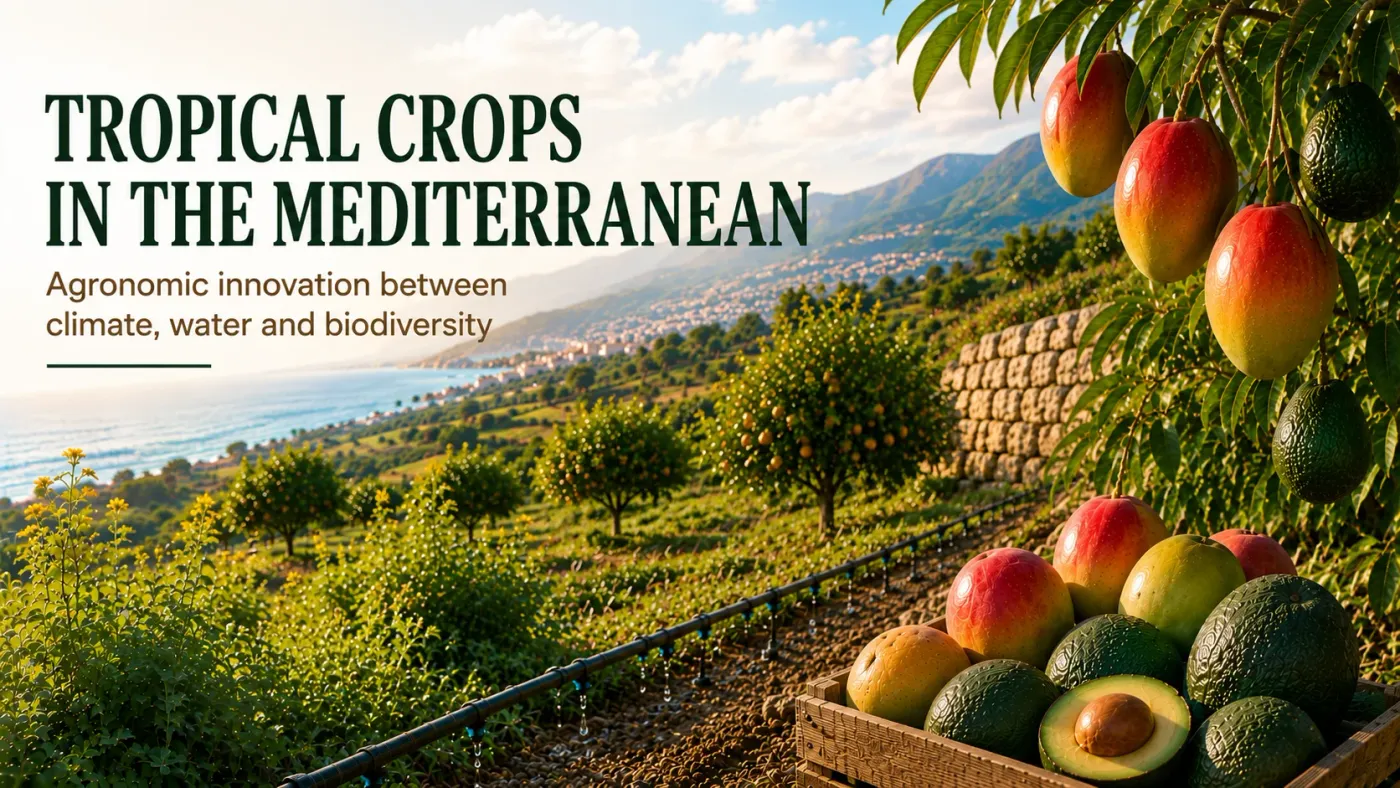
In recent decades, the global agri-food system has undergone profound transformations, driven by the interplay of climate change, demographic pressure, market globalization, and recurring food security crises. Within this context, the Mediterranean basin stands out as one of the most vulnerable—yet also one of the most promising—areas for the adoption of innovative agronomic practices. One of the emerging challenges—and at the same time one of the most stimulating opportunities—is the sustainable integration of tropical crops into Mediterranean environments, a field still relatively unexplored but attracting growing scientific and political interest.
At first glance, the idea of cultivating species native to tropical regions in Mediterranean areas may seem counterintuitive. However, it is increasingly supported by sound agronomic, climatic, and economic foundations. On one hand, rising average annual temperatures and increasing climate variability are gradually making many Mediterranean zones more similar—in some respects—to subtropical or high-altitude tropical climates. On the other hand, shifts in dietary preferences, the growing demand for exotic fruit in European markets, and the rising interest in more diverse and micronutrient-rich diets have made the cultivation of “non-traditional” species such as mango, avocado, papaya, passion fruit, guava, and even bananas economically attractive.
Sicily, southern Spain, parts of Greece, and southern Turkey are emerging as natural laboratories for this type of experimentation. In particular, in the province of Catania and along the coast of Almería, pioneering mango and avocado farming initiatives have been underway for years—often led by small and medium-sized agricultural entrepreneurs who have managed to blend local agronomic knowledge with technologies imported from the plants’ countries of origin. These experiences, however, raise crucial questions: What are the implications for water sustainability and biodiversity? How do these crops fit within existing local farming systems? What role might they play in combating desertification and revitalizing marginal agricultural economies?
The goal of this contribution is to offer a systemic and multidimensional analysis of the topic, combining a technical-agronomic approach with socio-economic and environmental reflection. This study aims to explore the pedoclimatic and agronomic conditions necessary for adapting tropical crops to Mediterranean environments, the main crop and irrigation management techniques adopted in successful case studies, the opportunities and risks associated with the introduction of such crops, and the European and national policies that may support or hinder this innovative process.
Particular attention will be devoted to the interaction between traditional Mediterranean practices—such as the use of terracing, rainwater harvesting, or agroforestry—and the specific needs of tropical species. In many cases, exotic crops can only reach a productive and sustainable balance if they are integrated into complex agroecological systems, thus avoiding the temptation to replicate high-impact intensive models.
The integration of tropical crops in Mediterranean contexts also aligns closely with the objectives of the European Commission’s Farm to Fork Strategy, as well as with the broader framework of the Green Deal and the post-pandemic resilience of agri-food systems. In this sense, it represents a paradigmatic challenge: it is not only about increasing productivity, but about building a type of agriculture capable of addressing the ecological, economic, and social discontinuities of our time, while also enhancing the bioclimatic and cultural uniqueness of the Mediterranean area.
Chapter 1 – Pedoclimatic and Agronomic Conditions for the Adaptation of Tropical Crops
The adaptability of tropical crops in Mediterranean contexts depends largely on local pedoclimatic conditions, which must be compatible with the physiological and phenological requirements of the introduced species.
1.1 The Mediterranean Climate in Transformation
The classic Mediterranean climate is characterized by mild, wet winters and hot, dry summers, with a marked seasonality in rainfall. However, over the past thirty years, a significant transformation in both temperature and precipitation regimes has been observed. Climatological data show a rising trend in average annual temperatures, with increasingly higher summer peaks, accompanied by a decrease in rainfall and an increase in extreme weather events. These transformations are making some coastal and inland areas of the Mediterranean increasingly similar to high-altitude subtropical regions, thereby opening up new possibilities for the cultivation of tropical species.
Certain areas of southeastern Sicily—such as the Gela Plain or the Noto district—present thermal conditions comparable to those found in parts of North Africa or Central America. These conditions include a thermal accumulation exceeding 3,000 growing degree days (base 10°C), which are essential for the flowering and fruiting of species such as mango, avocado, and papaya. The high solar radiation (over 2,500 hours per year) and the long growing season (more than 270 days) are additional favorable factors.
1.2 Ecological Requirements of Tropical Crops
Tropical crops require specific conditions of temperature, humidity, and soil in order to grow optimally. The mango (Mangifera indica), for example, requires minimum temperatures above 5°C to avoid cold damage but tolerates drought periods due to its deep root system. Avocado (Persea americana) is more sensitive to frost and suffers from excess soil salinity, but adapts well to well-drained soils rich in organic matter. Papaya (Carica papaya) is even more demanding in terms of temperature (minimums >10°C) and poorly tolerates strong winds and thermal fluctuations.
In Mediterranean contexts, varietal selection and crop micro-zoning become essential tools for successful adaptation. Some Mexican avocado ecotypes show greater cold resistance and are suitable for hilly areas, while mango varieties such as Kensington Pride and Keitt have proven more productive along the Sicilian coasts compared to other commercial varieties.
1.3 Mediterranean Soils: Potential and Limitations
The Mediterranean region features a wide variety of soils, ranging from limestone soils in inland hilly areas to alluvial soils in coastal plains. In general, Mediterranean soils tend to be shallow, low in organic matter, prone to erosion, and sometimes affected by salinity or sodicity—especially in intensively irrigated zones. Tropical crops—avocado in particular—are highly vulnerable in the presence of heavy or poorly drained soils, which can promote the spread of root pathogens such as Phytophthora cinnamomi.
Techniques such as minimal tillage, controlled cover cropping, the addition of compost and biochar, and the use of crop rotations with legumes help improve soil structure, fertility, and water retention capacity. Experiments conducted at the University of Palermo demonstrated that the inoculation of native microbial consortia significantly increases mango plants’ resistance to water and salt stress, while also reducing the need for synthetic fertilizers.
1.4 Water Resources and Irrigation Strategies
Water is undoubtedly the most critical resource in Mediterranean regions, where water scarcity is a structural issue, exacerbated by climate change. Tropical crops, particularly during the early stages of vegetative development, have significant water requirements. Mango typically requires between 8,000 and 10,000 m³/ha/year, while avocado may need up to 12,000 m³/ha in hot and dry climates, making the adoption of high-efficiency irrigation systems essential.
The use of micro-irrigation systems, soil moisture sensors, and forecasting models based on satellite data now allows for precision irrigation management, with water savings of up to 40% compared to traditional methods. Moreover, the use of treated wastewater, currently regulated by EU Regulation 741/2020, has proven to be a viable option in coastal areas, provided it is accompanied by careful monitoring of contaminants and the adoption of good agricultural practices.
1.5 Concluding Remarks
The adaptation of tropical crops in Mediterranean environments is neither an automatic nor risk-free process. However, it can be successfully achieved with accurate technical planning, supported by up-to-date climatic data, detailed pedological analyses, and targeted irrigation strategies. Existing experiences demonstrate that, where ecological conditions allow and management is careful and innovative, the introduction of tropical crops can represent not only a productive opportunity but also a means of regenerating marginal agricultural areas and promoting a new model of agroecological resilience.
Chapter 2 – Crop and Irrigation Management Techniques in Successful Case Studies
The introduction of tropical crops into Mediterranean contexts requires a deep transformation of traditional farming practices. This chapter examines the main agronomic and irrigation techniques that have contributed to the success of current initiatives, with particular focus on case studies in Sicily, Andalusia, and Crete.
2.1 Site Selection and Plantation Design
The design phase of the plantation is critical to the success of tropical crops in non-native environments. Site selection must consider a range of environmental and structural variables: altitude, exposure, slope, water availability, frost risk, and soil quality. It is essential to avoid low-lying areas where cold air tends to stagnate, or soils with poor drainage. Southeast-facing slopes are generally preferable in hilly regions.
In successful cases observed in Sicily and southern Spain, growers have adapted planting densities based on the species and variety selected. For avocado, spacing configurations of 6×4 or 5×5 meters are commonly used, resulting in densities ranging from 400 to 600 plants per hectare. For mango, a configuration of 6×3 or 6×2.5 meters has proven effective, as it facilitates rational pruning and easier canopy management.
2.2 Soil Fertility Management
Tropical crops require fertile soils, with good organic matter content and an adequate supply of both macro- and micronutrients. A widespread practice is the annual incorporation of compost, well-matured manure, and organic soil amendments such as biochar, which improves both the cation exchange capacity and the physical structure of the soil.
The most effective nutritional approach is fertigation, i.e., the application of water-soluble fertilizers through drip irrigation systems. This method allows growers to dynamically respond to the plants’ nutritional needs by monitoring the electrical conductivity (EC) of the solution and adjusting the pH to optimize nutrient uptake by the roots.
2.3 Pruning Techniques and Canopy Management
Pruning in tropical fruit crops serves a dual purpose: it controls vegetative growth and improves the penetration of light and air into the canopy. For mango, it is crucial to prevent the plant from developing an overly expansive structure, which would make harvesting difficult and increase the risk of fungal diseases. Summer pruning (green pruning) and winter pruning (dry pruning) are commonly used to keep the plant compact and productive.
In the case of avocado, it is important to balance vegetative growth with fruit production, avoiding alternate bearing—where a year of heavy fruiting is followed by a year of low or no yield. The use of open-vase pruning or the “Hass dome” shape—an inverted pyramid canopy—has become increasingly common.
2.4 Water Resource Management
Water efficiency is one of the most critical components of the entire system. Localized drip irrigation is the technological standard for all tropical crops adapted to Mediterranean contexts, as it reduces evaporation losses and allows for the integration of fertigation. In more advanced cases, Variable Rate Irrigation (VRI) systems are used, which enable differentiated water distribution based on the micro-zonal needs of the plantation.
The adoption of tensiometers and capacitive sensors to measure soil moisture content allows for on-demand irrigation, improving efficiency and reducing waste. An exemplary case is a farm in the Ragusa area that cultivates mango and avocado organically, using treated wastewater in accordance with EU Regulation 741/2020, while monitoring water quality through weekly analyses.
2.5 Plant Protection and Integrated Pest Management
Tropical crops are susceptible to specific pathogens and pests that may manifest in new forms in Mediterranean environments. The Mediterranean fruit fly (Ceratitis capitata), already known in Mediterranean agriculture, can attack mango and guava, while some species of scale insects and thrips can quickly colonize plantations in the absence of natural predators.
For this reason, successful experiences rely on Integrated Pest Management (IPM) strategies, which combine entomological monitoring, intervention thresholds, the use of pheromones and attractants, and the introduction of beneficial insects. In Sicily and Andalusia, there is increasing use of bio-insecticides (e.g., Bacillus thuringiensis, Spinosad) and insect-proof nets to protect plants during the most sensitive stages.
Chapter 3 – Opportunities and Risks: Ecological, Economic, and Social Implications
The integration of tropical crops into Mediterranean contexts raises a range of ecological, economic, and social implications that deserve careful analysis. This is not simply a crop substitution, but rather a systemic transformation that can affect the balance of local ecosystems, the dynamics of the agricultural market, and the social structures of rural communities.
3.1 Ecological Opportunities: Diversification and Resilience
From an ecological standpoint, the introduction of tropical crops can offer a significant opportunity to diversify Mediterranean cropping systems, which have often been degraded by decades of over-specialization. The presence of new species can enhance functional biodiversity, especially when integrated into polycultural or agroforestry systems. For example, intercropping avocado with citrus fruits or forage legumes can improve resource use efficiency, reduce pest pressure, and increase soil fertility.
In addition, many tropical crops—thanks to their deep root systems—contribute to soil stabilization and the reduction of erosion risk. However, these positive effects occur only in the presence of adequate agroecological design. If introduced into intensive systems with excessive use of fertilizers or unsustainable irrigation, tropical crops may lead to water stress, soil salinization, and the loss of natural habitats.
3.2 Economic Impacts: New Market Niches and Risks of Instability
From an economic perspective, the cultivation of tropical fruits represents a strategic opportunity to revitalize marginal agricultural areas and increase farm profitability. Market data show a steady growth in European demand for avocado (+15% annually from 2015 to 2022) and mango (+12%), driven by changes in dietary habits. In Sicily, family farms that have converted part of their citrus groves into organic avocado production have recorded a net increase of 35% in gross operating margin over three years.
However, this economic potential also comes with significant risks. International price volatility, dependence on long supply chains, and the need to meet high quality standards expose local producers to external shocks. There is also a risk that the adoption of tropical crops may be perceived as an “agronomic fad,” driven by unrealistic economic expectations.
3.3 The Social Dimension: Innovation and Rural Communities
The adoption of tropical crops also has a significant social dimension, as it affects the role of farmers, community dynamics, and the cultural perception of agriculture. In many Mediterranean contexts, tropical fruit farming has encouraged younger generations to enter agriculture, attracted by an innovative, niche production model. In Sicily, cooperatives have been established that bring together producers of organic mango and avocado for direct sales in farmers’ markets and high-quality restaurant circuits.
However, this shift in cropping systems can also generate social tensions, especially when it unfolds as an elitist or poorly participatory process. Land concentration and unequal access to water or technology may exacerbate existing inequalities between large and small farmers.
3.4 Toward a Sustainable Balance
The introduction of tropical crops into Mediterranean environments can act as a catalyst for ecological, economic, and social regeneration, but only if managed in a holistic and participatory way. Public support, through targeted agricultural policies, agro-environmental measures, and training programs, is essential to accompany this process. The post-2023 Common Agricultural Policy (CAP) provides tools to support crop diversification, organic farming, and short supply chain projects.
Chapter 4 – European Policies and Support Tools
The integration of tropical crops into Mediterranean farming systems is not only a technical or ecological matter—it also involves deep interaction with the regulatory and policy framework governing agriculture in Europe.
4.1 The CAP Regulatory Framework
The Common Agricultural Policy (CAP), historically focused on supporting traditional European crops, has shown a certain inertia in adapting to crop diversification and new climate challenges. However, the 2023–2027 CAP introduces elements of flexibility that can be leveraged to promote the cultivation of tropical species, if these are integrated into sustainable practices aligned with environmental goals.
Among the most relevant tools are the eco-schemes—voluntary direct payments linked to the adoption of virtuous agro-environmental practices. Tropical crops, when embedded within agroecological systems involving cover crops, rational water use, and integrated pest management, could fall within the criteria for these payments, even if not explicitly listed.
4.2 The Green Deal and the Farm to Fork Strategy
The European Green Deal, launched in 2019, aims to make Europe the first climate-neutral continent by 2050. Within it, the Farm to Fork Strategy serves as the cornerstone for the agri-food transition. In principle, the cultivation of tropical fruits in Europe can contribute to several goals of this strategy:
- Reducing emissions associated with the importation of tropical products from third countries (by lowering “food miles” and transport-related emissions)
- Diversifying production and increasing the resilience of local farming systems
- Promoting healthy and sustainable diets, in which exotic fruits like avocado, mango, and papaya are often valued for their fiber, unsaturated fats, and vitamin content
4.3 Rural Development Programs and Structural Funds
Beyond the CAP, numerous funding instruments can facilitate the adoption of tropical crops. The Rural Development Programs (RDPs), co-financed by the European Union and regional governments, offer specific measures for modernizing agricultural holdings, innovation and knowledge transfer, organic farming, and diversification into non-agricultural activities.
In Sicily and Andalusia, several producers have benefited from RDP funds for the purchase of micro-irrigation systems, anti-hail greenhouses, and digital climate monitoring tools. In Greece, the 2014–2020 RDP financed pilot projects for the cultivation of passion fruit and mango on a small scale in Crete, integrating agroforestry practices and agritourism pathways.
4.4 Institutional and Cultural Barriers
Beyond financial and regulatory aspects, there are also persistent cultural and institutional barriers hindering the spread of tropical crops. In some rural contexts, these crops are still perceived as “foreign” or “inauthentic.” This is further compounded by institutional fragmentation: responsibilities for agriculture, environment, water resources, and rural development are often distributed across different agencies, leading to inefficiencies in integrated policy management.
4.5 Proposals for Innovation-Friendly Governance
To overcome these barriers and promote a favorable environment for the development of tropical crops in Mediterranean regions, action is needed on multiple levels:
- Official regulatory recognition of tropical crops in agricultural registries and national strategic plans
- Simplification of bureaucratic processes and easier access to funding for innovative crop diversification projects
- Technical training and advisory support for farmers, local authorities, and public officials
- Creation of territorial cooperation networks among producers, universities, research centers, and professional organizations
- Inclusion of tropical crops in educational and outreach programs, to overcome cultural resistance
Chapter 5 – Toward a Hybrid, Resilient, and Sustainable Mediterranean Agriculture
The integration of tropical crops into Mediterranean contexts signals a deeper transformation affecting the very foundations of Mediterranean agriculture: cropping systems, the human-environment relationship, climate change adaptation strategies, and the development paths of rural communities.
5.1 Tropical Crops as Catalysts of Systemic Innovation
The introduction of tropical crops has shown the potential to act as a catalyst of systemic innovation in Mediterranean territories. It is not merely about cultivating new species, but about rethinking the entire agronomic logic: from plantation design to precision irrigation, from integrated fertigation to biological pest control, and from the creation of new local and short food supply chains to circular production models.
The success stories analyzed in Sicily, Andalusia, and Greece demonstrate that where a supportive ecosystem exists—in terms of knowledge, resources, and collaboration—tropical crop cultivation can become a strategic tool for agricultural regeneration in rural territories.
5.2 Conditions for Success
The effectiveness of an agronomic system is not measured solely by its productivity, but by its capacity to learn and adapt. Success cannot be mechanically replicated; rather, it depends on the ability to value local knowledge, build synergies among diverse actors (farmers, researchers, institutions), and intelligently interpret the specificities of each territory.
There is a need to promote models of co-designed agriculture based on interaction between technical experts and local communities. Crop choices should not be imposed “from above” nor guided solely by market logic, but co-constructed through participatory analysis of available resources, environmental constraints, and social opportunities.
5.3 Risks to Avoid
Alongside the opportunities, the concrete risks must not be overlooked. The first risk is that of unsustainable production intensification, already observed in some areas of southern Spain, where the expansion of avocado cultivation has put excessive pressure on water resources. The second risk is economic monoculture—dependence of entire regions on a single species or commercial supply chain. A third risk is that of territorial disconnection: cultivating avocado or mango must not mean abandoning the cultural and identity-based connection with Mediterranean agriculture.
5.4 Guidelines for an Agroecological Transition
In light of the evidence gathered, several operational recommendations can be outlined to support an effective and sustainable agroecological transition:
-
Integrated Local-Scale Planning — Regional and municipal governments should develop territorial agronomic plans that take into account the adaptability of tropical crops, water availability, compatibility with other crops, and the need to protect biodiversity.
-
Technical Support and Continuous Training — The success of tropical crop systems heavily depends on farmers’ training. Technical courses, mentoring networks, and digital decision-support tools are needed to spread best practices.
-
Promotion of Short Supply Chains — It is advisable to create local Mediterranean tropical crop supply chains, highlighting high-quality production, artisanal processing, and direct sales.
-
Facilitated Access to Public and Private Funding — Access to CAP, Rural Development Programmes (RDPs), and Next Generation EU funds must be simplified for tropical crops, with dedicated calls for proposals and clear guidelines.
-
Scientific and Participatory Monitoring — A permanent observation network on new tropical crop systems is necessary—one that involves research institutions, farmers’ associations, and citizens.
5.5 A Vision for the Mediterranean of the Future
The introduction of tropical crops into the Mediterranean, if guided by ecological intelligence and social sensitivity, can become a paradigm of Mediterranean resilience—a model of rural development that combines environmental sustainability, technical innovation, social justice, and landscape beauty. This does not mean replacing tradition, but regenerating it through hybridization. Just as the Mediterranean once embraced wheat from the East, the olive tree from the Levant, Arab citrus cultivation, and Phoenician viticulture, today it can become the cradle of a new temperate tropical agriculture, rooted in care, balance, and the co-evolution between humans and the environment.